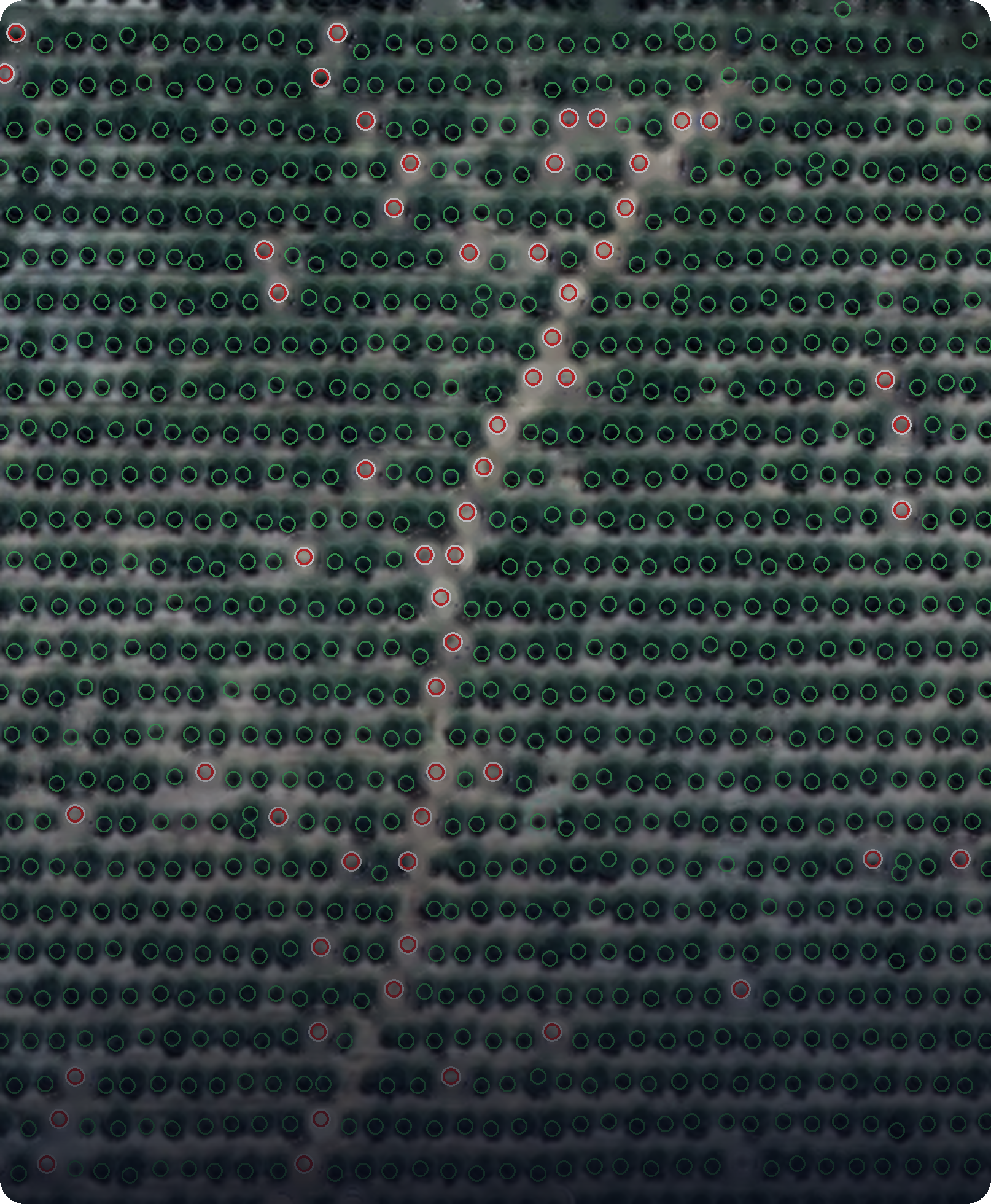
Your register may still include almond trees that are no longer there, and your next budget is paying for them.
The budget starts with the tree count.
If you have a large almond farm, you know exactly what I’m talking about. The budget for the upcoming season is taking shape, and every line item depends on a single number: how many trees you have and where they are.
Labour, water, treatments, the harvest forecast, how much you agree to deliver to buyers: it all comes from the plantation register. It’s a number people use so often that they rarely stop to check it.
Is your register still telling the truth?
Here’s the question worth asking before approving the budget: does your register still reflect the reality of your farm?
It’s not necessarily because someone made a mistake. It’s because farms change. Every season, trees are lost to frost, disease or machinery. Some blocks are removed, others are replanted, and not all of these changes make it into the register. The farm on paper and the real farm drift apart, silently, one tree at a time.
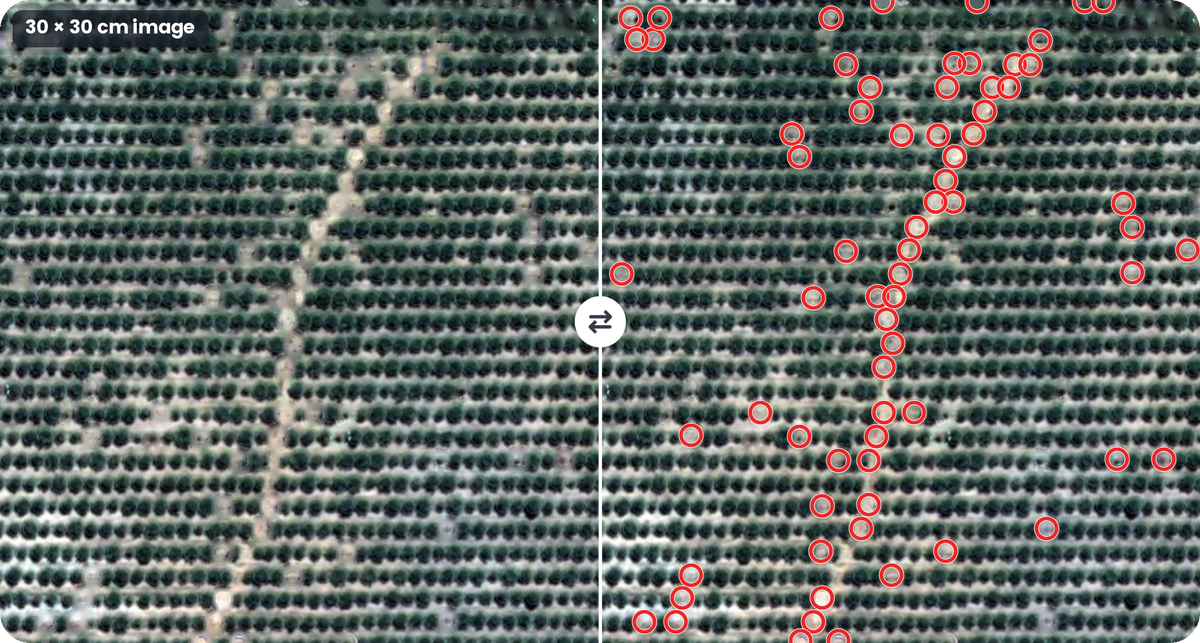
A tree that’s gone from the field can stay in the register for years.
A small gap with a big price tag.
When the register includes almond trees that aren’t there, that error goes straight into the plan. The budget covers trees that won’t need pruning, watering or harvesting, and the harvest forecast expects almonds that won’t arrive.
Checking isn’t simple either. Counting trees on foot across hundreds of hectares takes time, so the register is usually taken as correct.
How much does a tree that only exists on paper cost?
Official data from the Junta de Andalucía1 puts the annual production cost of an irrigated almond farm at EUR 2,430 per hectare, on farms planted at 7×7 m, around 204 trees per hectare. That’s about EUR 12 per tree, every year.
For every 1,000 trees that exist only on paper, about EUR 12,000 a year of planned cost would be tied to trees that aren’t there.
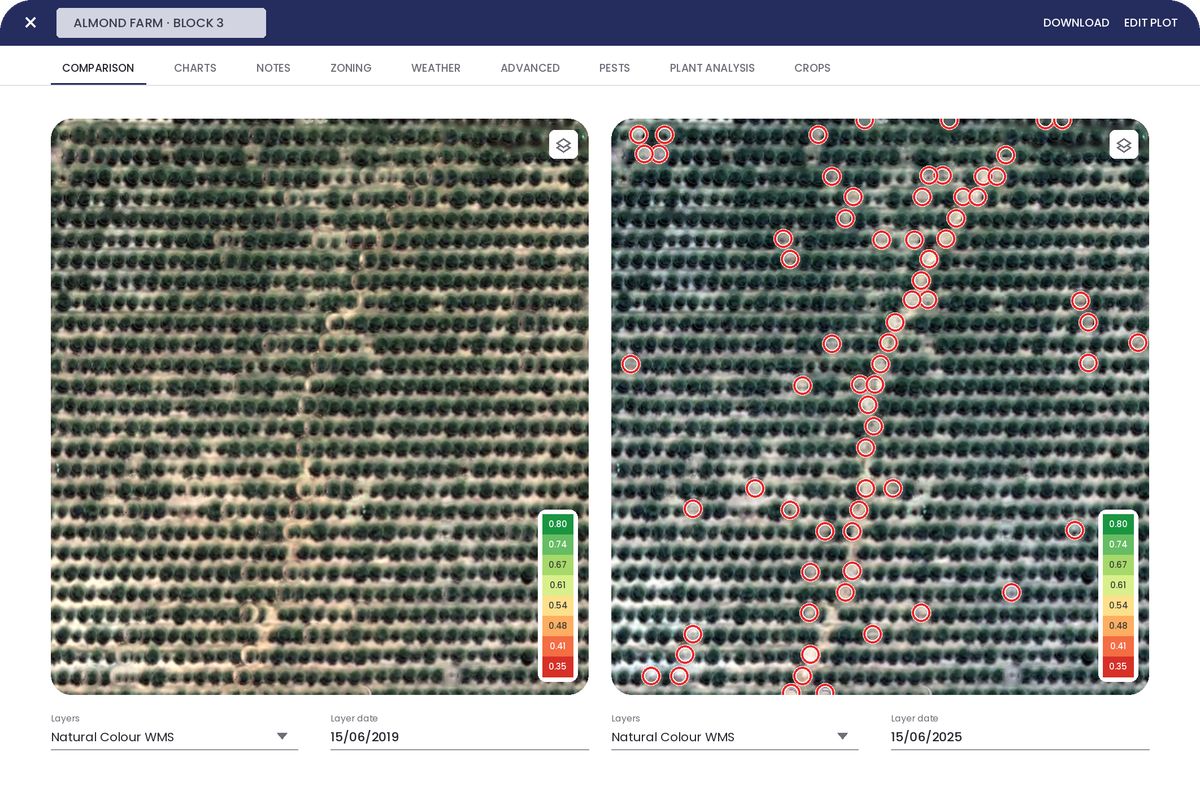
The register may still count every tree.
Counting the trees again, by satellite.
The quickest way to find out is to count the trees again, without walking the rows.
Using satellite imagery at up to 30 cm resolution, our AI models detect every almond tree on the farm on the date you choose. We then compare that count with your register, block by block.
You don’t just get a new total. You get a map of your farm that shows where the register matches the field and where it doesn’t, so your team knows which blocks to check first.
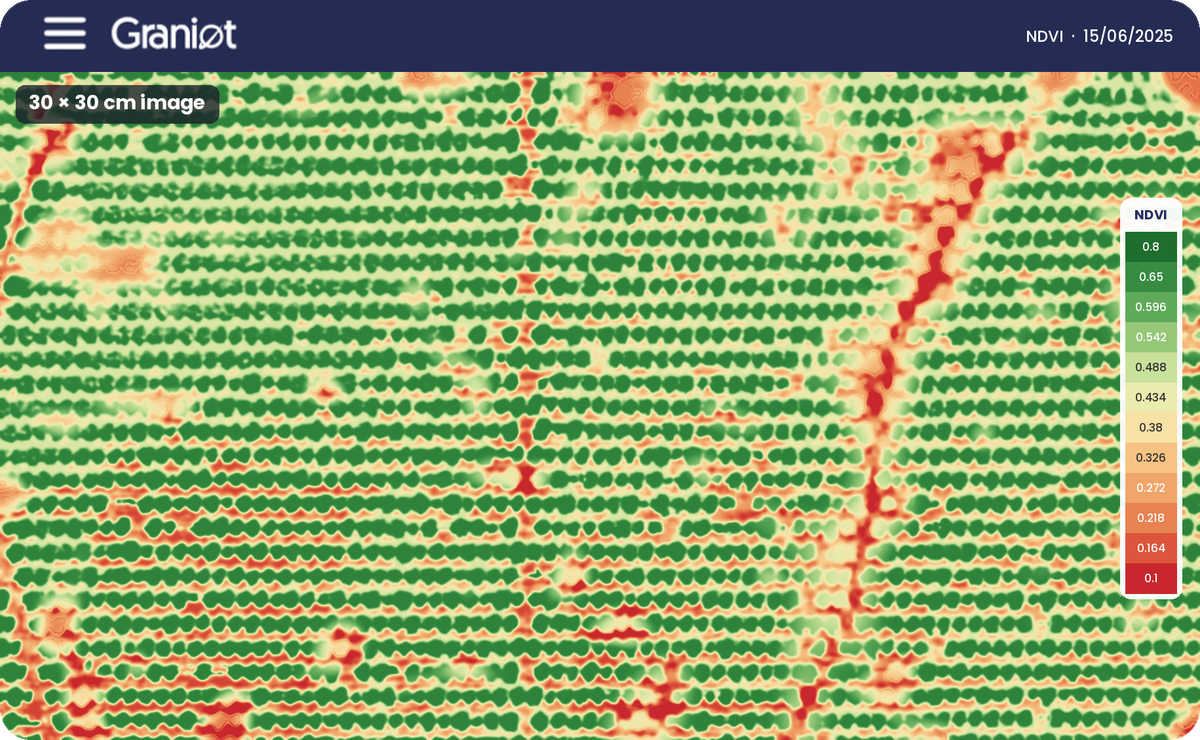
Red areas mark where trees are missing or struggling, the first places to check in the field.
Starting the season with the right number.
With an updated count, next season’s plan no longer depends on an estimate. You can approve the budget with figures you’ve checked, base the harvest forecast on the trees that are actually there, and send your field team only to the blocks that don’t match.
The same images also show the crown of each tree. That helps your agronomist see which blocks are still growing and which are already in full production, something the register doesn’t tell you.
How much you gain depends on what the count reveals and what you decide to change. But the season starts from the farm you actually have.
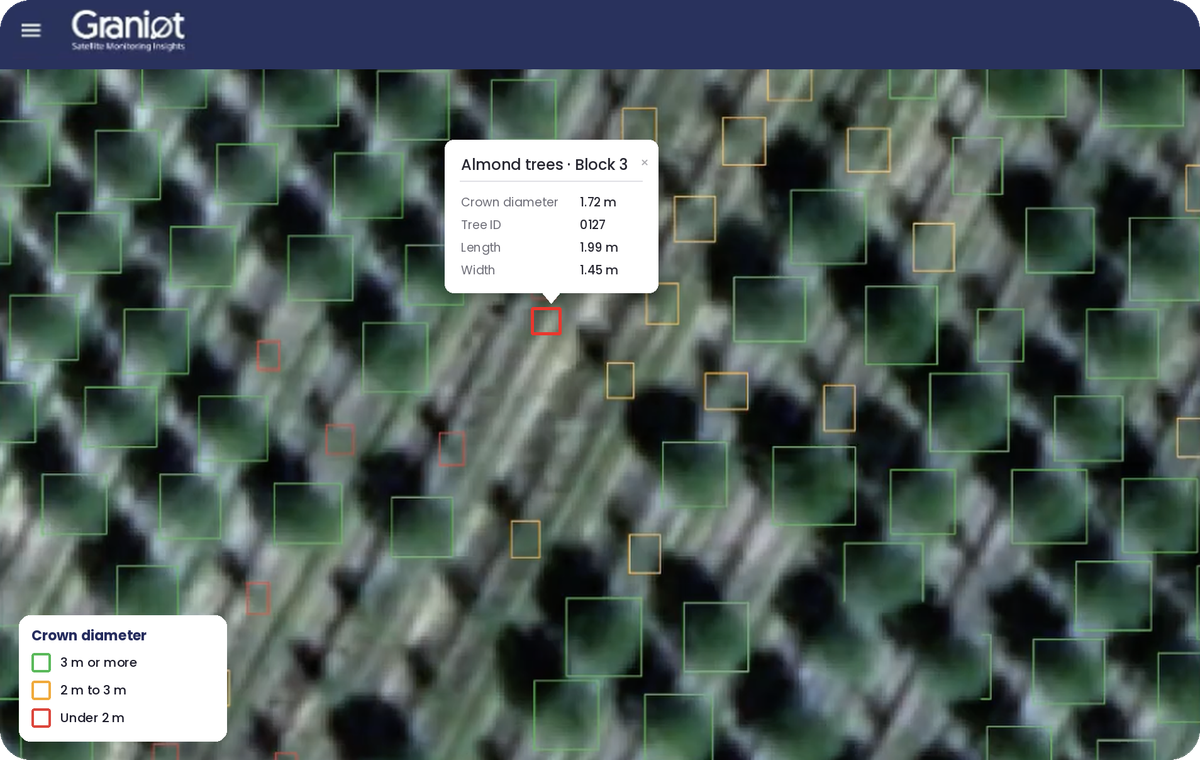
Select any tree to see its crown diameter and dimensions.
What the studies show.
The number of trees is only part of the story. Research on almond farms shows that the amount of light a tree’s crown captures is the biggest factor in how much it can produce. Studies in Spain have also found that crown size can vary a lot within the same farm, which means planning around an “average tree” can lead you to overestimate the harvest. Counting every tree and measuring every crown gives you a far more reliable starting point than the register on its own.
That said, there are things a satellite can’t tell you. A tree count doesn’t show a tree’s age, health or real yield, and it doesn’t replace a field visit when something needs checking. The cost per tree used in this article is a public average from the Junta de Andalucía, not a guaranteed saving. Some costs, such as water and machinery, are paid per hectare, and every farm’s costs are different.
Before your next budget
A satellite count won’t replace your agronomist or your field team. It tells them where to look first. So, when did you last check that your register still matches your field?
If you’d like to find out, our Satellite AI Assessment is a good place to start. In a two-hour workshop with your team, we review your register and your farm, and tell you whether a satellite count makes sense for you, what it could show and how to measure its value.
Leave us your details below and we’ll get in touch to take the first step together.
(Calculated from the 7×7 m planting pattern used in the same study (10,000 m² ÷ 49 m² per tree ≈ 204 trees per hectare).